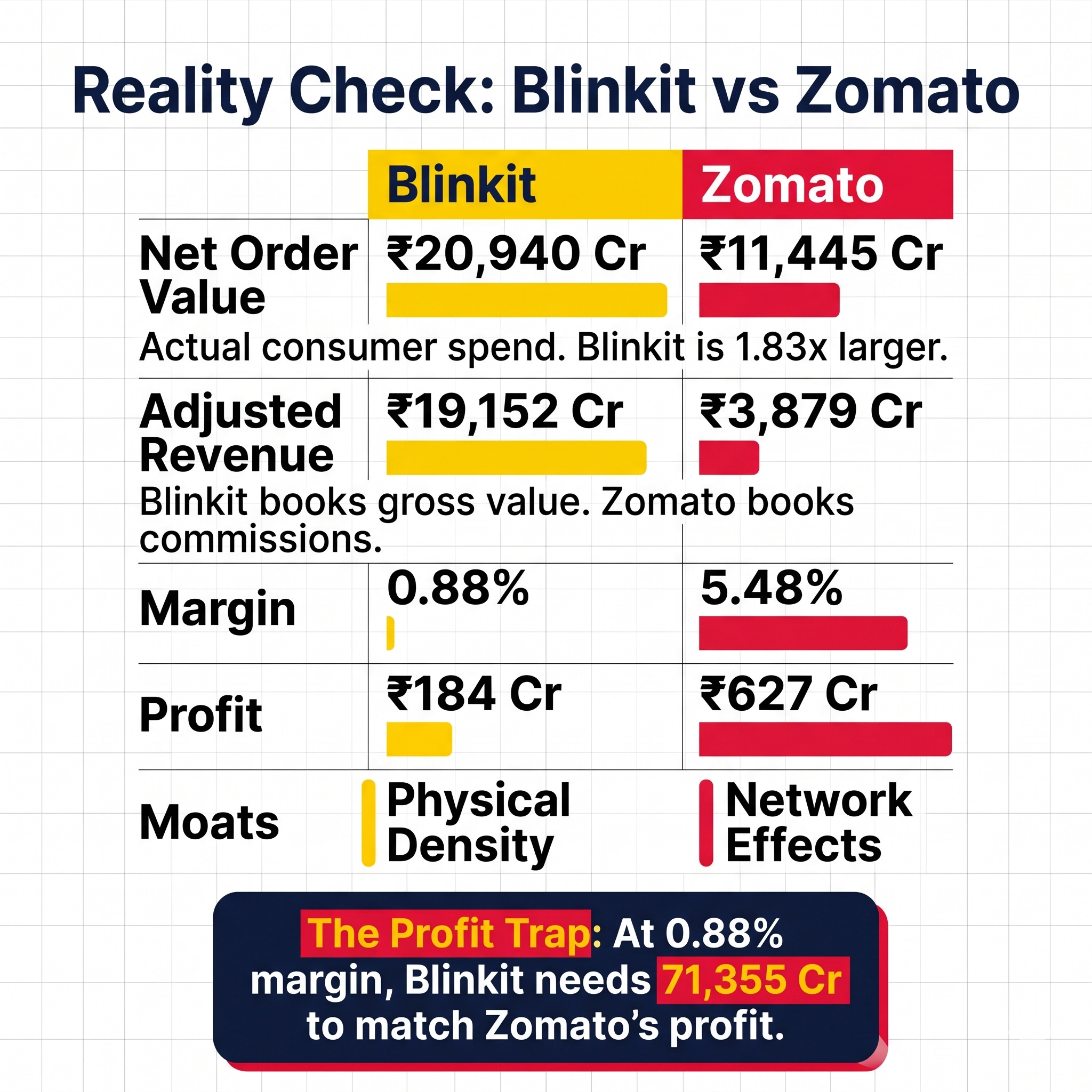
A lesson in the dangers of comparing retail revenues with software commissions, and why the food-delivery parent remains the true cash cow.
Social media platforms for professionals are curious places, where the ability to misinterpret an income statement is frequently mistaken for strategic genius. Over the past week, a breathless narrative has taken hold among India’s armchair analysts: Blinkit, the 10-minute grocery delivery upstart, has supposedly eclipsed its parent company, Zomato, by a factor of five.
The evidence for this claim? A cursory glance at Eternal Limited’s second-quarter results for the 2027 financial year. Blinkit reported a staggering ₹19,152 crore in adjusted revenue. Zomato’s food delivery business, by contrast, booked a mere ₹3,879 crore. Ergo, the child has swallowed the parent.
It is a compelling story. It is also mathematically true and functionally meaningless.
Comparing the top-line revenues of these two businesses is akin to a supermarket manager boasting that he makes more money than a software firm, simply because he logs the entire price of a loaf of bread at the till. Blinkit and Zomato operate under fundamentally different economic laws. To understand who is actually winning, one must strip away the accounting quirks and look at the underlying engines of profit.